Showing posts with label CLT 20. Show all posts

Thursday, 15 August 2013

The DRS should Eliminate Howlers. And Those Alone

By Vineet Goyal

Much has been written and debated about the effectiveness of DRS and it is fair to say that the jury is still out. Recent comments from Jacques Kallis are a good indication that the majority of players are not entirely comfortable with the system. However, most agree it is quite effective in eliminating blatant errors and the game is better off with some sort of DRS in place. Eliminating howlers was in fact the primary intended purpose of the system. So why is there still opposition to the system if it serves its primary intended purpose so well.

The answer lies in not what it does but in what it does not do effectively. It is completely ineffective in marginal decisions – the current technology used in DRS especially for predicting the trajectory of the ball in an lbw decision is not accurate enough for players and administrators to feel confident. But marginal decisions! No one was worried about those anyway – at least not the players. All we wanted was to eliminate the howlers for which DRS seems to work quite well. The problem however is that once the system is in place, we cannot ask the players to use it only in cases of a howler. The players realize that the technological shortcomings of the system can be exploited and therefore, they can use the DRS strategically to get a decision in their favor. This is very discomforting from everyone’s perspective.

The objective of DRS should instead be to eliminate howlers and just that. It would be futile to formally define a howler but in principle from the perspective of the batsman, we can think of a howler as a decision where the batsman feels (in his mind) that grave injustice has been done to him in giving him out. Now, an lbw decision where the ball was perhaps just hitting the top of middle stump is not a howler (assuming there was no inside edge and impact was inside the line of stumps) – in this case, a batsman would be disappointed but in his heart knows that he was beaten and perhaps out. Clearly, we cannot have a system where by rule the players can ask for a review only in case of a howler. This should happen by design. Here is a proposal that I feel should achieve this:

1. The batting team is allowed only ONE unsuccessful review for both the innings.
2. The bowling team is allowed two unsuccessful reviews per inning as in the current system.

The asymmetry in batting and bowling reviews is because of the asymmetry in knowledge between batsman and bowler. The batsman knows whether he nicked the ball almost surely but the bowler may not. 

So lets see how this system would play out. A batsman will review only if he is absolutely sure that he is not out. Except lbw decisions, the batsman knows whether he is out or not. Anyone who has played cricket would know that you feel the vibrations from the faintest of nicks and you know it. If the batsman didn’t edge the ball and is given out, the review will certainly reverse the decision – none of the technologies including hot-spot and snicko give a false positive. So non-lbw decisions will be ruled correctly. 

It is a bit more trickier for the lbw decisions because the batsman does not know whether the ball was going to hit the stumps or even whether the impact was in line or not. It’s amazing to see the performance of umpires on the elite panel currently – even the players would testify that the umpires are extremely accurate about things like estimated path of the ball and line of impact. Of course, they are humans and making real-time decisions, so they are bound to make marginal errors of a millimeter here and there. And I think the players are ok with such errors. If Kallis is beaten to an incoming delivery that is crashing onto the middle stump and hits him a millimeter outside the off-stump, I don’t think he will feel cheated if he is given out. The howlers in lbw decisions happen (at least these days) when batsman are given out after an inside edge which is easy for batsman to detect and then review. But since batsmen have only one unsuccessful review for two innings, they will not review marginal decisions.

What about the bowling team? Can they use it for marginal decisions? Since there are two unsuccessful reviews allowed, they might like it happens in the current system. However, this should not be a problem. This system does not produce false positives, i.e., if the batsman did not edge, there will be no hot-spot. So if the batsman is indeed not out, the system would rarely reverse the on-field not-out call. However, in case of a blatant error, the decision is reversed. Therefore, the DRS essentially comes into play only in blatant errors and has no impact in marginal decisions.

Tuesday, 2 July 2013

Kohli's captaincy in focus against favourite opposition

Match facts
Tuesday, July 2
Start time 0930 (1430 GMT)

MS Dhoni appeals for an lbw, India v Sri Lanka, Champions Trophy, 2nd semi-final, Cardiff, June 20, 2013
With MS Dhoni ruled out of the series, will Virat Kohli find his leading light? © Associated Press 
Enlarge
Big Picture
Triangular tournaments can be hard on the ego of the team that leaves the competition first. Unlike a bigger multi-team tournament, there is no consolatory semi-final finish, or a bronze medal. There is only a lonely last place. This series has just started, but with West Indies nine points clear of both India and Sri Lanka, that last-place tag, for now, has gravitated towards the two subcontinent sides. The familiar foes, who have played each other in five different countries in the last couple of years, both need a win in the last match of the series at Sabina Park to ensure some breathing space before the entourage moves to Port of Spain.
That these two teams know each other inside out is common knowledge. While the familiarity has worked in India's favour as their batsmen have decoded the unconventionality of Sri Lanka's attack, the same can't be said about the latter. They have repeatedly wilted against India's simple game plan - 'whatever you score, we'll do better'. The result is that when the two meet, it is almost like India's XI is up against Sri Lanka's IX, with the threat posed by Lasith Malinga and Ajantha Mendis to other teams reduced to a dud against India batsmen.
In cricket, however, most of the times, it is not a test of man-to-man strength. A special innings, an outstanding spell or even an exceptional instance of fielding is all that is required to overcome an opposition. On Friday, it was Chris Gayle who did that; on Sunday, it was Johnson Charles who blazed away. Sri Lanka have players who can do that as well - Kumar Sangakkara showed it against England in a tall chase at The Oval during the Champions Trophy - but the question is, can they do it against India?
India's juggernaut was brought to a halt on Sunday by West Indies, but only just. West Indies' bowlers set a template on how to stifle India's stroke-makers on a slow pitch, and their batsmen then rolled along comfortably as the surface eased out. In the absence of MS Dhoni, who didn't take the field after injuring his hamstring while batting, India fought hard, but were tripped by a resolute last-wicket stand. Virat Kohli, the stand-in captain, admitted the team missed Dhoni's calmness during that frantic ending.
Sri Lanka haven't been in their best form, but as West Indies proved, this young Indian side is beatable. With Dhoni ruled out of the rest of this series, the imbalance between the two sides has slightly been redressed.
Form guide

India LWWWW (Most recent first, last five completed matches)
Sri Lanka LLWWL
In the spotlight
Virat Kohli's reputation in world cricket received a huge boost the day he hammered the Sri Lanka bowling for a breathtaking century in Hobart in February 2012 . He scored two more against Sri Lanka in his next two matches, then another one three matches later. Since then, he has gone through a lean phase against other attacks. But when India met Sri Lanka in the Champions Trophy semi-final, Kohli helped himself to an unbeaten 58, dispelling any doubts about which team is his favourite opposition. In Kingston, Kohli will be burdened with captaincy, too, and it remains to be seen if he can flourish this time.
There is no doubt that Lasith Malinga has been one of the leading limited-overs bowlers in world cricket in recent times but what has been hard to fathom is why a top bowler has been unable to come up with a counter-strategy against Indian batsmen. He has ample skill, pace and variations in his armoury, but still he has failed to find the right combination that would work against the India batsmen. Players evolve during their careers but can Malinga do it?
Team news
While Ambati Rayudu was named as the replacement for Dhoni, the only reserve India batsman at the moment in the Caribbean is M Vijay, the opener. If he is included, the batting order will need a careful rejig. It is hard to see the team disturbing Rohit Sharma or Shikhar Dhawan at the top of the order.
India (probable) 1 Shikhar Dhawan, 2 Rohit Sharma, 3 Virat Kohli (capt), 4 M Vijay, 5 Dinesh Karthik (wk), 6 Suresh Raina, 7 Ravindra Jadeja, 8 R Ashwin, 9 Bhuvneshwar Kumar, 10 Ishant Sharma, 11 Umesh Yadav
Sri Lanka's move to open with Mahela Jayawardene and Upul Tharanga paid dividends, but the rest of their batting slowed the innings down on Friday. But they do not have much room to wiggle in their batting order. However, one move they might consider given the slow nature of the Kingston pitch could be to include Sachithra Senanayake.
Sri Lanka (probable) 1 Mahela Jayawardene, 2 Upul Tharanga, 3 Kumar Sangakkara (wk), 4 Dinesh Chandimal, 5 Angelo Mathews (capt), 6 Lahiru Thirimanne, 7 & 8 two of Ajantha Mendis/Sachithra Senanayake/Jeevan Mendis, 9 Nuwan Kulasekara, 10 Rangana Herath, 11 Lasith Malinga
Pitch and conditions
The conditions at Sabina Park have meant batsmen have struggled for fluency in the first half of the match and they are likely to stay the same. It is a slow pitch with some lateral movement early on, but it eases out during the second half. Just like West Indies did both times, the team that wins the toss will prefer to field.
Stats and trivia
  • India and Sri Lanka have played 41 ODIs against each other in the last five years - that is 15 more than the next most-prolific match-up of Bangladesh-Zimbabwe. Overall, the two teams have met each other 140 times in ODIs, also a record. Australia-West Indies have played against each other 135 times.
  • It's not a surprise then that three Sri Lankans and four Indians have scored more than 1000 runs in such contests in the last five years, the top-seven batting efforts against a particular team. Shane Watson, with 930 runs against England, is the eighth batsman in this list.
  • The India and Sri Lanka bowlers haven't done quite as well as their batting counterparts. It's understandable since most of these matches are played on flat wickets. For wickets taken against a particular opposition in the last five years, three Sri Lanka bowlers are in the top 10 for doing it against India. Lasith Malinga is there, too, but the opposition in his case is Australia. Only one India bowler - Zaheer Khan v Sri Lanka - makes it to the list.
Quotes
"There were times when you are under pressure and you miss him (Dhoni) because he remains calm under pressure."
Stand-in India captain Virat Kohli on the narrow loss to West Indies

Sunday, 14 October 2012

All-round Henriques sinks Chennai


A blistering stand of 75 between Moises Henriques and Steve Smith towards the end of the innings was the difference, as Sydney Sixers' 185 was enough to keep out Chennai Super Kings in a high-scoring contest at the Wanderers. Henriques made telling blows on the field as well, as his three middle-order wickets derailed Super Kings' chase just as the asking rate started reducing. Suresh Raina threatened with an attacking half-century, but the lack of support at the other end hurt Super Kings' chances.
Shane Watson scored 46, Chennai Super Kings v Sydney Sixers, Group B, Champions League Twenty20, Johannesburg, October 14, 2012Shane Watson gave the Sixers a rousing start after they were put in to bat, and Chennai's spinners hit back with wickets, but none of the bowlers were spared once the Smith-Henriques pair came together.
Shane Watson's 46 laid the foundation for a strong total © Associated Press 
Enlarge
Watson was harsh on anything short, and he made R Ashwin and Jadeja pay by cracking sixes over the on side. Only a run-out could have ended Watson's stay and he fell in that manner four short of a fifty. He attempted a risky second run but wasn't quick enough for Ben Hilfenhaus' fiery throw from deep cover, which hit the stumps on the half volley.
The spinners pulled things back for Chennai after Watson's departure. R Ashwin struck twice in an over, removing Brad Haddin and Nic Maddinson as they tried to push the scoring. It wasn't the worst thing to happen to the Sixers, though, as it brought Smith and Henriques together. The pair began by bashing two boundaries down the ground off the part-time leg spin of Faf du Plessis and from that point on, an above-par score looked possible. The bowlers hemorrhaged 61 off the last four overs, which included eight fours and three sixes. Bollinger and Hilfenhaus, who were held back for the final overs, came in for some stick as the pair of Smith and Hilfenhaus muscled boundaries and played some cheeky ramp shots to exploit the infield.
Super Kings got off to a circumspect start, limping to 7 for 1 after three overs. Du Plessis gave the chase a push with a flurry of boundaries through the off side, charging the fast bowlers to unsettle their rhythm, in particular Pat Cummins. Cummins had the last laugh, though, when du Plessis advanced down the track to launch a straight six but couldn't clear long-on.
Sixers captain Brad Haddin risked introducing his spinners when Suresh Raina walked in. Raina targeted his favourite cow-corner region against the left-arm spin of Steve O'Keefe and was also alert to put away the length offerings from the seamers. The bowlers didn't exploit Raina's weakness against the short ball and with every Raina boundary, the game was Sixers' to lose.
Like they had done with the bat, the Henriques-Smith pairing proved decisive, this time in the field. Raina aimed for the long-on boundary off Henriques' medium pace, but Smith took a well-judged catch at the edge of the rope. Henriques struck two balls later with MS Dhoni's wicket and that had all but sealed the game for Sixers, with 44 needed off the last three overs.

Saturday, 13 October 2012

Daredevils too pacy for Knight Riders


What prompted Gautam Gambhir and Kolkata Knight Riders to bat second, under the lights, in South Africa, is unclear. And the plan clearly did not come off; it went horribly wrong on a track that had unreliable bounce, which the Delhi Daredevils' four-man pace attack used wisely after 60 overs were played out on the pitch. The Knight Riders were not only outplayed by 52 runs, five of their batsmen got struck, including the team's batting mainstay Jacques Kallis. Their top-order had an outing they'd do well to forget.
Daredevils' pace-attack cut through Knight Riders' line-up with ease © AFP 
Enlarge
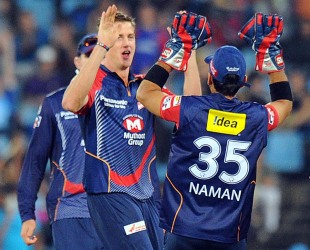
Morne Morkel celebrates a wicket with his team-mates, Kolkata Knight Riders v Delhi Daredevils, Group A, Champions League Twenty20, Centurion, October 13, 2012Out of 168 day-night limited-overs internationals in the country, only 27 teams have won the game after deciding to bat second. At the SuperSport Park, only one team has won in ODI cricket while none have done so in Twenty20 internationals. And against an attack that includes the towering Morne Morkel, the Knight Riders were swimming against the tide willfully. The uneven bounce confused them further and by the time the first ten balls of their innings were done, Daredevils had done enough damage.
It started with the captain Gautam Gambhir, when Irfan Pathan removed him for a duck off the third ball, having the left-hander chip one to mid-on. Off his sixth ball, he brought one back into the other opener, Manvinder Bisla, who was trapped leg-before. Irfan had one of those better evenings, when he looked like bringing the ball back whenever he pleased. It got worse for the Knight Riders when Brendon McCullum cut one to Chand at point off Morne Morkel's first ball, the seventh of the innings, for a duck.
Jacques Kallis was the next man to walk off when Morkel rapped him on the fingers of his right hand while trying to fend off an awkward delivery. He had to retire hurt and did not come back to bat, but X-rays revealed that there was no fracture. The very next ball struck the next batsman, Irfan, on his arm, as he attempted to leave a rising delivery. At the end of the fifth over, he was put out of misery when Daredevil's first-change bowler Umesh Yadav had him deflect one back at the stumps. By this time the ball started keeping low too. Manoj Tiwary and Rajat Bhatia added 47 for the fifth wicket but it was only a face-saving exercise.
Irfan, Morkel and Yadav took two wickets each and Ajit Agarkar got one; except for the left-arm swing bowler, the other three struck the batsmen and kept them pinned on the backfoot.
Daredevils too were in trouble when they batted, but the recovery was prompt. The 63-run fourth-wicket stand between Unmukt Chand and Ross Taylor put them in a strong position, especially after a 30-run 17th over from L Balaji.
Chand played some attractive shots to start off his innings and survived a chance on 14 at midwicket, where Tiwary dropped a skier. He cracked two sixes and two more boundaries to finish on a 27-ball 40. It ended when he completely missed an off-break from Sunil Narine. The versatile spinner took three wickets while Brett Lee and Kallis bowled well too. But it would be the costly overs from Balaji that they could pinpoint for conceding more than the average score at the venue.
Following Daredevils' resounding win, Pietersen will be off to London to meet with England team director Andy Flower on Sunday. He is likely to be back in time for Daredevils' second game, on Friday in Durban, against Auckland Aces.

Where are the 'Champions' in Champions League?


Let's not bemoan that cricket is not simply cricket anymore because it has been taken over by side shows. We've known that for a while and secretly a lot of us like it because it is, even if it is just a little, fun. Who doesn't like a bit of dancing in between regular life? In the middle of all the fun, we could forget about the real issues that surround a tournament like this.eaders and fireworks. So, in other words, a lot.
On face value, it is very difficult to take the Champions League T20 seriously.
It is not, as its name suggests, a competition of winners. After all, the second, third and fourth placed teams in a league of nine are participating along with the runners-up of some tournaments and victors of others.
Priyanka Chopra hands Harbhajan Singh the Man-of-the-Match cheque, Mumbai Indians v RCB, CLT20 final, Chennai, October 9, 2011Beyond the format, there are other oddities. The opening concert will be headlined by a person who calls himself DJ Earworm, a mash up artist. For those who don't know that does not involve potatoes but mixing of sounds to form what the Billboard 100 charts say is very popular music. What that has to do with cricket is as much as cheerl
The economic law of supply and demand has been enough to steer the course of the Champions League © AFP 

The imbalanced nature of the competition is its greatest flaw. With four IPL teams, two South African franchises and two Australian gaining automatic entry into the event, the rest are right to feel a little left out. Of the remaining Full Member countries, two - Zimbabwe and Bangladesh - were not even invited to qualify while the other five were give two spots to fight over. Even those were not evenly handed out as England were allowed two teams in qualifying while Pakistan, New Zealand and Sri Lanka were only permitted one each.
The result is a main event that just does not seem fair. If the marketing says the competition will be played between champions, why are so many absent?
The answer lies where so many other answers do: in money. When a novel concept like the CLT20 was mooted, its intentions must have been to play a real league of champions. The boards of India, South Africa and Australia quickly realised the only way they could make money out of it would be if more Indian teams were involved to appeal to larger Indian audience, who the advertisers pay to target.
That economic law of supply and demand was enough to steer the course of the entire tournament. Because more Indian teams need to be involved, fewer other teams can participate to avoid the event becoming much longer. Because South Africa and Australia are shareholders, they needed to see some benefit other than having a stake in it, so they get two teams. Because everyone else is not part of the administration of the tournament, they get what's left over.
Surely then some concoction of a tournament name like the 'Ind-SA-Aus T20 with invited guests' would be more appropriate and more honest. It would settle the question about who really owns the competition, who benefits from it and who dictates terms. It would be a private event and no-one would have any right to complain about it.
Such a neat solution is not possible though, because the ICC endorses the CLT20 in its current form. Why else would they permit a window for it in every year on the FTP? No other multi-team tournament that is not a World Cup (even the Champions Trophy is at an end) and certainly no other domestic event has this right. The game's governing body has rubber stamped the CLT20 and that would give it little reason to alter its composition in future.
Perhaps ICC involvement could make a difference in future, if it assumes some governing rights over the CLT20. Take UEFA's Champions League, which the CLT20 is often compared with, as an example. First of all, note that the top three leagues in Europe are allowed to enter four teams into the event, while some of the other countries are not even given a spot, so even the footballing equivalent is skewed.
 
 
Surely then some concoction of a tournament name like the 'Ind-SA-Aus T20 with invited guests' would be more appropriate and more honest. It would be a private event and no-one would have any right to complain about it.
 
The difference is that the system used in European Football is based on rankings, not ownership of an event. UEFA use a footballing coefficient to determine which leagues are placed where on the rankings system. The coefficient takes into account how the clubs from each country have performed in previous Champions Leagues, so those who have done better in the past have more spots in the future.
A system like that would ensure that Trinidad and Tobago are rewarded for reaching the 2009 final and could even see a team like the Sialkot Stallions get some recognition for holding the world record for the most consecutive wins in the 20-overs format. It would mean that money does not control the entire organisation of the event, as it does now.
Even moving the tournament to South Africa was, to some extent, driven by money. A Pakistan team could probably not have toured India with the current tensions, and religious festivals across the country would have made it difficult to host at certain venues. Instead, South Africa, default hosts for everything from the African Nations' Cup that was due to be held in Libya to a Champions Trophy once destined for Pakistan, were asked to step in so money that would be made from this year's CLT20 is not lost.
CSA itself will not make much more money from the event. They will receive the same shareholding as usual and will have to pay the hosting fees to stadiums out of that cash. It could result in them getting less money. Additional income will stem from hotel, airline and restaurant revenue as a large number of people descend on the country for the showpiece.
Make no mistake that it will be a showpiece. Despite the administrative issues, the tournament remains a home to some of the world's best players. Almost every big-name player, be it in the 20-overs format or not, is participating. World T20 Man-of-the-Series Shane Watson will turn out for Sydney, Sunil Narine and Kieron Pollard will play for their respective IPL sides, exciting prospects like Chris Morris of the Lions, Gary Ballance of Yorkshire and Shahbaz Nadeem of Delhi will be able to make names for themselves.
But even on the playing side, there is an strangeness. The player whose name is almost permanently aligned to a T20 competition, Chris Gayle, is absent. Gayle has played in every 20-overs competition besides New Zealand's and England's (he played for Worcestershire but not in the shortest format). Remarkably, none of the teams he represented made it to the main draw of the tournament.
Gayle was due to play for Uva Next in the SLPL but had to withdraw because of injury, meaning even if they had got past the qualifiers, he would not have been in their squad. His absence is so extraordinary that Mahela Jayawardene, who will captain Delhi, was even able to crack a joke about it. "Obviously Chris has set standards and he will be missed," he said. "But he has to lift his game and try and bring one of his teams to CLT20 next year."
Now that is something to take pretty seriously indeed

Thursday, 11 October 2012

Sohail fifty leads Sialkot home


Sialkot Stallions' Haris Sohail made an unbeaten 63, Hampshire v Sialkot Stallions, Champions League T20, Johannesburg, October 11, 2012
It was a match of no consequence for either team, but Sialkot Stallions will leave South African shores with greater confidence, having put in an all-round performance against the English domestic champions. Two individual performances from youngsters on either side stood out - Haris Sohail's unbeaten 63 the highlight, as it was a match-winning knock. Glenn Maxwell scored a counter-attacking 42 when his team, Hampshire, needed runs, but a score of 143 wasn't imposing enough for Sialkot.

Haris Sohail's unbeaten 63 made the difference © AFP 
Enlarge

A combined bowling effort by Sialkot kept Hampshire to that score, well short of what Trinidad and Tobago had managed earlier in the day, with only 31 runs scored in the last five overs. Hampshire lost early wickets in search of quick runs, scratched around for the first ten overs, surged in the middle overs thanks to an entertaining cameo from Maxwell but lost their way after his dismissal. It was a pitch that offered something for the spinners and seamers. Sarfraz Ahmed, the tall left-arm seamer with an unusual action, got a few to bounce off a good length to pose questions for the openers. Shoaib Malik got turn and bounce and those that skidded through weren't easy to put away either.
Hampshire would have ideally liked one from the top order to bat through for the majority of the overs, but regular strikes stalled their progress. The run-outs didn't help - they lost two of their top order off direct hits. Hampshire had only managed 59 off the first ten overs and it was up to their overseas picks to give the innings a push.
Maxwell was harsh on the pull, connecting a few off the seamers and sending the ball several rows over the on side. He picked Naved-ul-Hasan for consecutive sixes in an over which yielded 16, and added 56 with Shahid Afridi. However, Sialkot pulled things back with a quiet over by the seamer Bilawal Bhatti, whose skiddy pace kept Maxwell in check. Hampshire were 113 for 4 after 16 overs and in the search for quick runs, both Maxwell and Afridi fell off successive balls off Umaid Asif. The lower order though failed to push the score past 150.
The Sialkot top order didn't look at ease against the Hampshire seamers, limping to 26 for 2 after the Powerplay. A couple of pressure-relieving boundaries by Sohail off the left-armer Chris Wood put Sialkot on the path to stability. It helped to have the experienced Malik at the other end as they calmly pushed the singles in between. Sialkot were 62 for 3 after ten overs, just three ahead of Hampshire's at the same stage.
Malik showed some aggressive intent, charging the left-arm spinner Liam Dawson and launching him for a six and four off consecutive deliveries. Crucially, Sialkot didn't let themselves get bogged down with a boundary drought - the pair ensured they picked up at least one boundary per over on an average. From the 11th to the start of the 18th over, when they were separated, they picked up ten boundaries. It also hurt Hampshire that their most experienced bowler, Afridi, couldn't effect the breakthroughs or stem the flow of runs. Sohail pounced on anything short and wide from Afridi, and by the time the spinner picked up a wicket - that of Malik - Sialkot were well on course needing 20 off 17. Malik's 96-run association with Sohail had all but sealed the game. It was a pity though that the tournament format didn't allow Sialkot to build on the momentum.

Tuesday, 9 October 2012

Kyle Mills sets up Auckland's crushing win


Sialkot Stallions entered their maiden Champions League T20 with an awe-inspiring domestic record. They had won Pakistan's Twenty20 competition seven out of nine times and possess a world-record winning streak of 25 matches. However, on a Wanderers pitch that bounced and seamed, they were undone by Auckland Aces' pace attack and their own desire to swing with abandon.
The predominant features of Sialkot's innings were batsmen playing and missing and an abundance of dot balls; their attempts at counter-attacking were short lived. Their batsmen cleared the Wanderers' boundaries ten times but managed to score only 130. It was the third-lowest total for an innings that contained ten sixes; the first two were chases in which the target was easily achieved.
The target was well below par and Auckland's openers, Martin Guptill and Lou Vincent, handled the bounce better than their counterparts did. The opening stand of 32 put the chase on course and the second-wicket stand of 51 between Guptill and Azhar Mahmood gave them an opportunity to win with a high net run-rate. They lost a couple of wickets in quick succession but New Zealand's domestic champions managed to get home with 17 balls to spare.
Gareth Hopkins, the Auckland captain, got what he wanted despite losing the toss, and Kyle Mills and Michael Bates made excellent use of the conditions. On a green-tinged pitch, the right and left-arm combination harried the Sialkot openers with short-of-a-length deliveries. After Imran Nazir was smacked painfully on the glove, Shakeel Ansar attempted a big hit in Bates' first over and holed out to mid-on. The No. 3 batsman Haris Sohail took 12 deliveries to get off the mark, before Nazir ended two consecutive maiden overs by pulling Bates over the fine-leg boundary.
There were 24 dot balls in the first five overs, after which Sialkot were 11 for 1. Mills' figures were 3-1-4-0. The sixth went for plenty. Mahmood's length was poor and Sohail hit him for two sixes in an over that cost Auckland 18. Both Sohail and Nazir, however, were caught at point attempting aggressive shots in successive overs, leaving Sialkot 30 for 3.
Shahid Yousuf was Sialkot's best chance at recovery and he hit Andre Adams, bowling extremely quick for a five-step run-up, for consecutive sixes in the ninth over. In the next, Yousuf took two fours off Colin Munro's only over. At the other end, however, Shoaib Malik was struggling, scoring only 3 off his first 11 deliveries.
Yousuf was reprieved twice off Ronnie Hira - Hopkins failed to collect and stump the batsmen - before the spinner took a catch off his own bowling to stunt the Sialkot recovery. Malik's innings ended via a catch at long-off and Sialkot slumped to 97 for 6 before the tail got stuck into Hira's final over, the 18th. Naved-ul-Hasan and Ali Khan took 21 runs off it. Mills, however, returned to clamp down on Sialkot once again. His last over went for only two runs and he finished with figures of 4-1-6-2.
Faced with a middling target, Auckland began the chase aggressively. Vincent charged, pulled and slashed to provide the early propulsion. He was beaten often as well, but managed 20 off 16 balls before being caught at third man on the cut. Guptill began at around run a ball and steered Auckland through the first half of the chase. His only six came in the tenth over, a 98 metre blow over long-on, and he was out in the next, pulling powerfully to the fielder on the midwicket boundary.
Then followed Auckland's most tentative phase, as Mahmood and Colin de Grandhomme were dismissed in the space of four balls by Sarfraz Ahmed, a left-arm bowler who delivers off the right foot but well after his front foot as landed. The asking-rate, however, was never an issue and Anaru Kitchen and Colin Munro hacked at the equation with a series of powerful blows to accelerate the finish.

Monday, 8 October 2012

Sialkot Stallions finally get stage to strut their stuff


Two of the teams at this year's Champions League would have made their first appearance in at the inaugural edition of the tournament in 2008.
The Titans have had the opportunity to qualify every year since then but only got it right in 2012. The other, the Sialkot Stallions, did not have that same chance. Relations between India and Pakistan soured after the Mumbai terror attacks of November 2008 and Pakistan players and teams found themselves shut out of the competition.
If a representative from Pakistan had been let into the tournament in the previous three editions, that team would have been Sialkot in two of them. They were Pakistan's domestic winners in 2009 and 2011, and 2012 - Lahore Lions took the crown in 2010. And if the Champions League existed before that, Sialkot would have participated in most of those editions too.
So prolific has their form in the shortest format of the game been, that Sialkot have won seven of the nine editions of Pakistan's domestic 20-overs competition. They also hold the world record for the number of consecutive victories by any team in T20 cricket, with 25 wins.
As far as reputations go, Sialkot enter the qualifying stage with one of the biggest and theirs serves as proof that they belong at this level, something their captain Shoiab Malik has never doubted. "Wherever cricket is being played, Pakistan cricketers should go and play there," he said. "We know there are certain rules and regulations, but that is my opinion."
Sialkot, Malik believes, will take their chance to show what they are about. "We really like this format and we have done well in it. This tournament is an opportunity for us."
The two other teams in their group, Auckland and Hampshire admit to knowing very little about the Pakistan champions but the numbers and Malik's strong words should be an indicator of what they are up against.
Part of their prowess could come from the mystery factor. "There is an advantage for us because the other teams haven't seen some of our youngsters who have not played international cricket," Malik said. He mentioned bowlers Umaid Asif (who is "not young though, actually quite old") and Bilawal Bhatti (whose "name may be very difficult for you to pronounce but just look at it on his shirt") as examples.
Pakistan's newest international left-arm spinner Raza Hasan, who Malik said the media "must have noticed at the World T20," is also in the Sialkot squad and big things are expected of him. Malik seems to want bigger things from the more experienced members of the squad though.
He hopes the likes of Imran Nazir, Naved-ul-Hasan and Sarfraz Ahmed can show that although Pakistan, as a place, has been in the international wilderness, their domestic competition is thriving. Importantly, he pointed out that these players have travelled enough and played enough to be more than ready to compete in a tournament like this.
"We have some players who were with the Pakistan team and a lot of our others have been playing in England for the past 10 or 12 years," he said. "They have that awareness of the game and they have played with international cricketers before."
Despite their bravado, Sialkot lost a warm-up match to Yorkshire by 23 runs on arrival. Malik blamed a heavy travelling schedule and poor timing for the defeat. "We arrived in South Africa at around midnight on Saturday evening and played the game the next morning. We were very tired and we are still a little tired. But it's great to be here, it's a great tournament and we are know we are prepared for it."